7 Types of Work Environments and Who They Fit
Compare seven types of work environments, from traditional offices to coworking, hybrid and remote work, with honest trade-offs and tips for choosing.

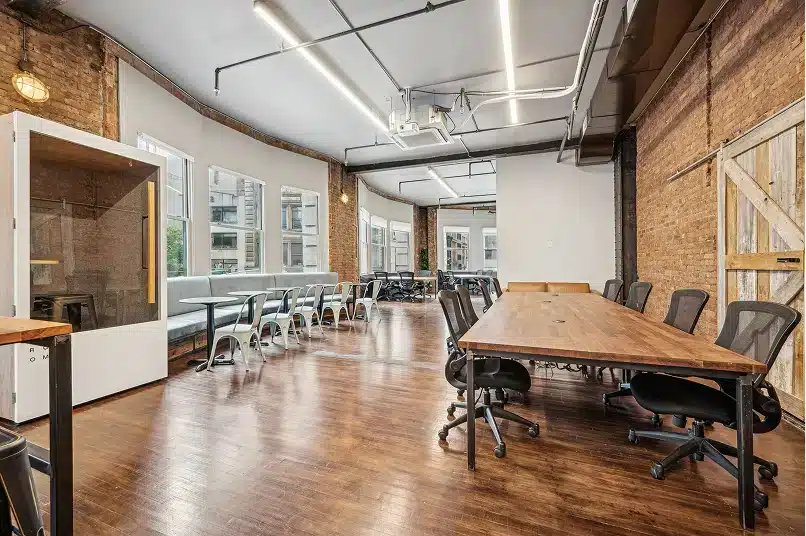
Ask ten people where they work and you get ten answers that sound like addresses, schedules or personalities: a kitchen table in Queens, three days a week in Midtown, a startup where everyone talks across the room. Each of those describes one of the types of work environments people now choose between, sorted by where the work happens, how often you show up and what the culture feels like.
The choice used to be made for you. Today most office jobs come with options, and freelancers and founders have even more. The catch is that modern work environments are easy to describe and hard to compare, because the brochure version of each one leaves out what it costs and who it quietly frustrates.
We run a coworking space in Manhattan, so we watch people move between these setups every month. Here is what each one is really like, and how to tell which one fits you or your team.
What Defines a Work Environment
Every work environment sits somewhere on three axes. Place is where the work physically happens: an office, a home, a shared space. Schedule is how often you are there in person. Culture is how people behave once they are there: collaborative or competitive, structured or loose.
Most lists of work environment types mix all three together, which is why you see “remote” next to “competitive” next to “open plan.” They are not the same kind of choice. You pick a place and a schedule. You mostly inherit the company culture from your employer, or build it if you are the founder.
This guide sorts the options by place and schedule, because that is the part you can actually decide this quarter. Culture still matters, and it gets its own section further down, because it decides whether any of these setups actually works.
The shift is real and it has settled. As of May 2026, Gallup’s tracking of remote-capable US employees found 52 percent working hybrid, 26 percent fully remote and 22 percent fully on-site, a split that has held steady since 2022.
The 7 Types of Work Environments
Here is the short version before the detail. The seven setups run from most structured to most flexible.
| Type | What it looks like | Best for | Watch out for |
|---|---|---|---|
| Traditional office | Your company’s own leased space, five days a week | Teams that collaborate in person all day | Fixed costs, long leases, commute |
| Activity-based office | No assigned desks, zones for focus, calls and meetings | Mixed work that changes through the day | Needs enough quiet space to work |
| Private office in a flexible workspace | A lockable room for your team inside a shared building | Small teams that want privacy without a lease | Price per person rises fast as you grow |
| Coworking space | A hot desk or dedicated desk in a shared room | Freelancers, founders, solo remote workers | Noise, less privacy for calls |
| Hybrid work | Home some days, office or coworking on others | Employees with flexible schedules | Coordinating in-office days with the team |
| On-demand rooms | Day offices and meeting rooms booked by the hour or day | Offsites, client meetings, interviews | Availability on busy days |
| Fully remote | Home office or anywhere with Wi-Fi | Focused solo work, distributed teams | Isolation, blurred home and work time |
A Traditional Office Wins When Everyone Shows Up Daily
A traditional office is space your company leases and runs itself, with assigned desks or rooms and a five-day rhythm. It is still the default for firms where work depends on people being in the same room all day: trading floors, studios, many law and finance teams.
The strength is predictability. Everyone knows where to find each other, teamwork happens in hallways, and new hires learn by watching colleagues work. The weakness is cost and commitment. Commercial leases in New York commonly run for years, and you pay for every desk whether or not anyone sits at it.
Inside a traditional office environment, layouts usually come in three forms. Private rooms are expensive per person, so they often go to senior staff or roles that handle confidential work. Cubicles sit in the middle, with some visual privacy and almost no sound privacy. Open plans put everyone at shared tables.
Layout matters more than most teams expect. Open plans are often sold as a way to get people talking, but a Harvard Business School study of two companies that moved to open offices found face-to-face interaction dropped by roughly 70 percent, while email and messaging went up. People put on headphones and wrote to the person ten feet away.
An open floor does not create collaboration. People do, when they also have somewhere quiet to go.
That is why well-run traditional offices mix open areas with closed rooms, phone booths and at least one quiet corner. If you are designing one, budget for enclosed space early, because it is hard to add after the furniture arrives.
Activity-Based Offices Let the Task Pick the Desk
In an activity-based office, nobody owns a desk. The floor is divided into zones, and you move to the one that fits what you are doing: a quiet room for focused work, a booth for a call, a big table for a working session, a lounge for a quick catch-up.
The idea follows how a real workday goes. Most people do not spend eight hours on one kind of task, so a single desk is rarely the best place for all of it. When the zones are right, people spend less time fighting their surroundings and more time working.
It fails in a predictable way. If the company cuts desks but does not build enough quiet rooms, the setup becomes a crowded open plan with no assigned seats. Ask how many focus rooms and booths there are per person before you judge one.
Good office design shows up in small things here: natural light, sound control, enough power outlets, and shared spaces that people actually choose to use. Many coworking spaces are built this way by default, with a lounge, phone booths, conference rooms and a quiet area under one roof.
Private Offices Give Small Teams a Door That Locks
A private office in a flexible workspace is a furnished room that only your team uses, inside a building that handles the internet, cleaning, kitchen, reception and meeting rooms. You sign a membership rather than a multi-year lease, and you can usually move to a bigger room as you grow.
This setup fits teams of roughly two to twenty people who need privacy for calls, confidential work or simply personal space, but do not want to manage a lease, a buildout and an IT contract. You get the feel of your own office with the shared amenities of a larger one.
The trade-off is price per person. Private offices cost more per seat than open coworking desks, and the gap widens as the team grows. At some size, usually when a team fills a whole floor, a dedicated lease starts to make more financial sense again.
Coworking Spaces Rent You a Desk and a Community
A coworking space is a shared workspace where members rent a hot desk (any open seat) or a dedicated desk (your own seat, every day) along with Wi-Fi, coffee, printing, phone booths and bookable meeting rooms. Members come from different companies, which is the point for many of them.
For freelancers and solo remote workers, the appeal is mostly human. You get a reason to leave the house, a routine that separates work from home life, and people around you who run their own businesses. Those meaningful connections are hard to plan and easy to miss when you work alone.
The downside is noise and privacy. A busy shared room is not where you want to take a sensitive call or write for four hours straight. Before joining, check how many phone booths there are, whether there is a designated quiet area, and how full the room gets in the middle of the week, when most hybrid workers come in.
A hot desk suits people who come in a few days a week and do not mind moving. A dedicated desk suits people who come in most days and want to leave a monitor and a plant behind.
A Hybrid Work Environment Is Now the Default
A hybrid work environment splits the week between home and a shared workplace. For employees, that usually means a company office two or three days a week. For freelancers and small teams without an office, it often means home most days and a coworking space or day office on the others.
Hybrid works best when the in-office days have a purpose. Teams that come in on the same days for planning, reviews and in-person problem solving get real value from the commute. Teams that come in on random days to sit on video calls at a desk get the commute and none of the benefit.
The practical question for hybrid workers without a company office is cost. Paying for a full membership you use two days a week is wasteful, while a per-day pass gives you a desk only when you need one. That math changes once you are in four or more days a week, at which point a membership usually wins.
Hybrid is also a work-life balance decision. Home days give you back commuting time. Office days give you a clear end to the workday, which many people find harder to create at home.
Working hybrid without a company office? Compare a day pass with a coworking membership and see which one matches the days you actually come in.
On-Demand Rooms Make Any Setup More Flexible
On-demand space means booking a room only for the hours you need it: a day office for a team offsite, a conference room for a pitch, a quiet room for interviews. It is not a full work environment on its own. It is the piece that makes the others work.
A flexible work environment built this way suits remote teams that meet in person once a month, founders who need to meet clients somewhere professional, and companies whose own office has no room big enough for the full team. You pay for the room, the screen and the coffee, then walk away.
The catch is availability. Popular rooms can book up weeks ahead, so teams that rely on on-demand space should reserve recurring dates in advance rather than hunting for a room the week before.
Fully Remote Work Trades the Commute for Discipline
A remote work environment means there is no office to go to. Work happens at home, in a cafe, or wherever there is a reliable connection, and the team meets through collaboration tools and the occasional in-person gathering.
It is a stable group, not a passing phase. In the Gallup data above, about a quarter of remote-capable employees work fully remote, and that share has barely moved since 2022.
Remote work is excellent for long stretches of focused solo work and for teams spread across time zones. It is harder on new hires, who lose the casual learning that happens near colleagues, and on anyone whose apartment doubles as an office. Without a clear boundary, the workday leaks into the evening.
Fully remote also has a paperwork side people forget. A remote business still needs an address for contracts, invoices and filings, and many founders do not want their apartment number on all of it. A business address solves that part without adding a desk, as we explain in our guide to a virtual mailbox vs a street address.
What Makes a Positive Work Environment
Place and schedule are only half the decision. A positive work environment is one where people can do their best work and want to keep doing it, and it can exist at a kitchen table, in a coworking space or on a leased floor. It can also fail in all three.
The link to output is measurable. In a six-month study of call center workers at a British telecom company, researchers from Oxford, MIT and Erasmus University Rotterdam found that employees were 13 percent more productive in weeks when they reported being happier, making more calls per hour and converting more of them into sales.
Positive Culture Travels With the Team, Not the Floor Plan
A positive workplace culture comes from how people treat each other, not from the furniture. It shows up as clear expectations about response times, protected time for focused work, open communication about problems, and in-person days that have a reason to exist.
That is why moving to a nicer space rarely fixes a struggling team on its own. A new office can make good habits easier, but it will not create them. Employee engagement in hybrid and remote teams usually depends more on how meetings, feedback and recognition work than on where people sit.
Small Physical Details Shape Employee Morale Every Day
The physical side still matters, mostly through things people notice only when they are missing. Natural light, a chair that adjusts, a screen at eye level, a quiet place for calls and a clean kitchen all affect how a long day feels, and they are cheap compared with the cost of people avoiding the office.
Layout can also show up in health records. A Danish study of 2,403 office employees found that people in open-plan offices with more than six occupants had 62 percent more days of sickness absence than people in private cell offices. The study shows an association, not proof that open plans cause illness, but it is a good reason to keep enclosed rooms in any layout.
Good employee morale rarely comes from perks alone. It comes from a setup that matches the work, plus a culture that lets people use it well.
How to Choose the Right Work Environment
The best way to compare different types of work environments is to start from how your week actually looks, not from the setup that sounds most modern. Five questions get you most of the way.
- How many days a week do you need to be in person with your team or clients? Zero points to remote, one to three to hybrid or on-demand rooms, four or five to an office, coworking membership or private office.
- How much of your work needs quiet? Writing, coding and analysis need real focus space, so look for booths and quiet rooms, not just desks.
- How many people need to sit together? One person rarely needs more than a desk. A team that handles confidential calls needs a door.
- How long can you commit? A lease locks you in for years, a membership for months, a day pass for a day.
- Do you need a business address? If clients or filings need one, factor it in, whether it comes with your office or as a separate service.
Among all the types of workplaces described here, none is best in general. The right one is the cheapest setup that covers the days you truly need to be somewhere.
What Type of Work Environment Do You Prefer?
Hiring managers ask what type of work environment do you prefer to check whether you will be happy and effective in their setup. They are not looking for a perfect match. They want to see that you know how you work best and can adapt.
A strong answer names a setup, explains why with one example, and shows flexibility. For instance: “I do my best work in a hybrid setup. I like quiet home days for deep work, and I value in-person days for planning with the team, because that is where we solved the hardest problems in my last role. I’ve also worked fully on-site and adapted well.”
Research the company’s actual arrangement first, and be honest: naming your preference now saves you from a job that drains you later.
Where The Farm Fits Into These Options
The Farm SoHo is a New York coworking and business services company that has run flexible workspace in Manhattan for more than ten years, with Manhattan locations in SoHo (447 Broadway) and NoMad (1178 Broadway). Several of the types of office spaces in this guide live under the same roof, so people can move between them without changing buildings.
For hybrid workers, a day pass costs $29, and a 30-day bundle costs $250 to use within three months. For someone who comes in two or three days a week, that bundle works out to about $83 a month. A coworking membership starts at $150 a month for a hot desk (an intro rate for first-time members) and $419 for a dedicated desk, with 24/7 keyless access, phone booths and a quiet area we call the Tree House.
For small teams, private offices start at $850 a month. For offsites and client meetings, day offices and conference rooms can be booked by the hour, with conference rooms starting at $50 an hour. Remote founders who only need an address can use a virtual office, which starts at $62.50 a month billed annually and includes three coworking days a month.
And if your ideal work environment includes your dog, our Manhattan spaces are pet friendly.
The Short Version
Work environments differ by place, schedule and culture, and only the first two are fully yours to choose. A traditional office fits teams that need each other every day. Coworking and hybrid setups fit people who need a desk some of the time. Remote work fits focused, self-directed work, as long as you build the structure the office used to give you.
Pay for the days you need to be somewhere, not the days you imagine you might.
Frequently Asked Questions
What are the main types of work environments?
The main types are traditional offices, activity-based offices, private offices in flexible workspaces, coworking spaces, hybrid work, on-demand rooms and fully remote work. They differ mainly in where work happens and how often people are there in person.
What is the difference between hybrid and flexible work?
Hybrid work is a set schedule that splits the week between home and a workplace. Flexible work is broader and covers any setup where you choose when or where to work, including booking space only when you need it.
Which type of work environment is best for introverts?
Usually one with plenty of quiet space: remote work, a private office, or a coworking space with phone booths and a designated quiet area. What matters most is having a place to retreat for focused work, not the label of the setup.
Is coworking good for remote workers?
For many, yes. It adds structure, a separate place to work and people around you, without the cost of a lease. It is less suitable for people who spend most of the day on confidential calls, unless the space has enough private booths or rooms.
What makes a positive work environment?
Clear expectations, open communication, protected time for focused work and a physical setup that matches the job: enough quiet space, natural light and comfortable furniture. Culture travels with the team, so a new office helps only when the habits come with it.
When should a small team move from coworking to a private office?
Usually when confidential calls become frequent, when the team needs to leave equipment set up, or when finding seats together becomes a daily problem. Compare the monthly cost of the team’s desks with the price of a room that fits everyone.
How do I answer “What type of work environment do you prefer?”
Name the setup you work best in, give one concrete reason, and show that you can adapt. Check the company’s actual arrangement first so your answer fits the role you are applying for.
Want to try a few of these setups before you commit? Start with a day pass, book a tour of the space, or ask us which option fits how your team works.
Sources
- Gallup. Global Indicator: Hybrid Work. https://www.gallup.com/401384/indicator-hybrid-work.aspx
- Bernstein, E. S. and Turban, S. The impact of the “open” workspace on human collaboration. Philosophical Transactions of the Royal Society B, 2018. https://doi.org/10.1098/rstb.2017.0239
- University of Oxford. Happy workers are 13% more productive (2019). https://www.ox.ac.uk/news/2019-10-24-happy-workers-are-13-more-productive
- Pejtersen, J. H. et al. Sickness absence associated with shared and open-plan offices. Scandinavian Journal of Work, Environment & Health, 2011. https://www.sjweh.fi/show_abstract.php?abstract_id=3167

A hot desk, whenever you need it.
Drop in for a day or come every day. No reservation needed.


Related Articles

Are Coworking Spaces Profitable? What the Numbers Actually Show
Almost everyone who works from a full coworking floor does the math at some point. Every desk is taken, there’s a line for the phone booths, the coffee machine never rests, and forty people are paying a few hundred dollars a month each. From the inside, it looks like an easy business. So, are coworking […]

What Does It Mean to Have an On-Demand Workspace Strategy?
It’s Tuesday morning. You need a quiet desk near a client in SoHo for the day, a room for four people at two o’clock, and nowhere to be on Wednesday. Signing a lease for that week makes no sense, and neither does paying a monthly fee for a desk you’ll use six times. That gap […]

Hot Desk vs Dedicated Desk: Which One Fits How You Work
Two people join the same coworking space on the same Monday. One grabs whatever seat is free by the window, works for six hours, packs up and leaves nothing behind. The other walks straight to the same desk as last week, where a second monitor, a notebook and a small plant are waiting. Both pay […]

Stay ahead of the curve
Virtual office tips, business address guides, and workspace insights, once a month, straight to your inbox.